🤖 AI Password Cracking in 2026: Why Machine Learning Has Made Your Old Passwords Obsolete
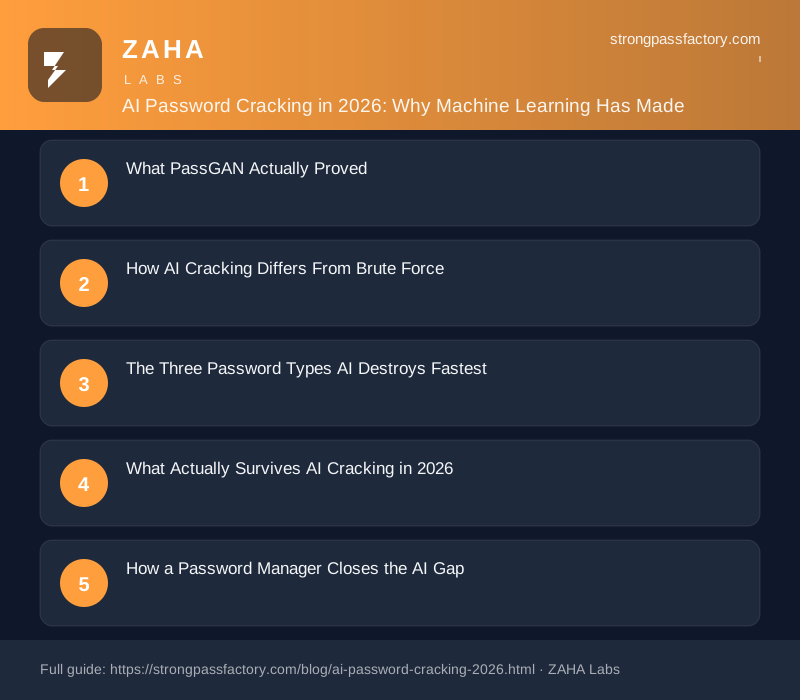
On this page
PassGAN — a neural network trained on 15.6 million leaked real-world passwords — cracked 51% of common passwords in under one minute and 65% within an hour in Home Security Heroes' 2023 benchmark. AI-powered cracking tools have permanently lowered the bar: an 8-character password that once took weeks to break now falls in seconds, and the new minimum for a genuinely safe password is at least 15 characters of true randomness.
If you are still using passwords shorter than 12 characters, or passwords built on dictionary words with predictable substitutions (P@ssw0rd, anyone?), read this before logging into anything sensitive today.
What PassGAN Actually Proved
In April 2023, Home Security Heroes published a benchmark running PassGAN against 15.6 million real passwords from the RockYou breach dataset. The results rewrote conventional wisdom about password length:
| Password length | Numbers only | Lowercase only | Mixed case + numbers | All character types |
|---|---|---|---|---|
| 4 characters | Instantly | Instantly | Instantly | Instantly |
| 8 characters | Instantly | Instantly | 8 minutes | 7 hours |
| 10 characters | Instantly | 4 weeks | 6 years | 5 years |
| 12 characters | 25 seconds | 3 years | 3,000 years | 34,000 years |
| 15 characters | 1.5 years | 1 billion years | Quadrillions of years | Quadrillions of years |
| 18 characters | 27 years | Billions of years | Practically infinite | Practically infinite |
The takeaway is unambiguous: length beats complexity at every tier, and 15+ character passwords with mixed character types are computationally out of reach for current AI systems. An 18-character all-lowercase password takes billions of years to crack; an 8-character "complex" password with symbols takes just 7 hours.
How AI Cracking Differs From Brute Force
Traditional brute force tries every combination in sequence — from aaa to zzz and beyond. It is thorough but slow. For an 8-character password using 95 possible characters, that is 6.6 quadrillion combinations.
AI cracking does something far smarter. PassGAN and similar models learn the statistical structure of how humans actually choose passwords. They know that:
- People substitute predictable characters:
@fora,3fore,0foro - People append numbers at the end:
password1,jessica92,dragon2024 - People use keyboard patterns:
qwerty,123456,asdfgh - People capitalise only the first letter and add a symbol or number at the very end
By generating candidates that match these learned patterns, AI tools skip billions of improbable combinations and head straight to the ones humans actually choose. According to Specops Software's 2024 Breached Password Report, 88% of passwords used in real-world attacks were 12 characters or fewer — exactly the range where AI cracking is most destructive.
"Attackers no longer need to brute-force every combination. They train on your leaked peers, predict your psychology, and skip straight to the most likely candidates." — Troy Hunt, founder of Have I Been Pwned
The Three Password Types AI Destroys Fastest
Not all short passwords are equally vulnerable. These three categories fall within minutes regardless of how "complex" they appear:
- Leet-speak substitutions —
P@ssw0rd,S3cur1ty!,Tr0ub4dor. These are among the first guesses a trained GAN generates because leet substitution patterns are universally represented in breach training data. - Name + year combinations —
Sarah2024,Michael1987,Jessica2025!. The model has learned that names precede years, capitalisation follows name conventions, and exclamation marks append at the end. - Dictionary words with appended numbers —
sunshine99,baseball2023!,monkey1234. The RockYou dataset alone contains millions of examples of this pattern. PassGAN has memorised all of them.
What Actually Survives AI Cracking in 2026
Two properties make a password genuinely resistant to AI-powered attacks:
- True randomness. A password like
f7!Kq#mZ9xW2@pL3was not generated by a human brain — it has no statistical pattern for a neural network to exploit. StrongPassFactory generates passwords using a cryptographically secure random number generator (CSPRNG) that produces output no AI model can learn to predict, because there is nothing to predict. - Length above 15 characters. As the table above shows, a 15-character password with mixed characters sits in computationally infeasible territory for any current or near-term attack. Even if AI hardware improves tenfold, cracking time drops from quadrillions of years to hundreds of billions — still completely unreachable in any meaningful timeframe.
How a Password Manager Closes the AI Gap
The obvious question after seeing that table: who can remember a unique 18-character random password for every account? Nobody can, nor should they try. That is not a human failing — it is an architectural reality. The correct solution is a password manager that:
- Generates cryptographically random passwords of 20+ characters for every site
- Stores them encrypted behind a single strong master password that you choose to memorise
- Autofills them so you never need to type or recall individual passwords
- Alerts you when a stored password appears in a known data breach
NordPass does all four. Its built-in generator defaults to 20-character random strings using letters, numbers, and symbols — placing every generated password firmly in the "quadrillions of years" column of the PassGAN table above. NordPass uses XChaCha20 encryption with a zero-knowledge architecture, meaning even NordPass's own team cannot see your stored passwords. Its Data Breach Scanner also monitors your email addresses and saved passwords against known breach databases in real time.
To put this in concrete terms: if you stored a NordPass-generated 20-character password for your email account, and an attacker had a GPU cluster running PassGAN at one trillion guesses per second, they would still need longer than the current age of the universe to crack it.
Frequently Asked Questions
Can AI crack passwords that have never appeared in a data breach?
Yes — but speed depends entirely on human pattern. AI crackers exploit the statistical regularities of how humans choose passwords. A truly random 15+ character password that has never appeared in any breach dataset is essentially immune to this attack vector: the AI has no pattern to learn from and effectively reverts to near-random guessing, which is computationally infeasible at that length.
Is 12 characters still safe in 2026?
Only barely, and only with full character diversity and genuine randomness. The PassGAN benchmark shows 12-character mixed passwords take 3,000 years to crack — but that assumes true randomness. A human-chosen 12-character "complex" password with predictable substitutions can fall in hours. NIST SP 800-63B's 2024 guidelines recommend a minimum of 15 characters for standard accounts and 20 for privileged accounts. At 15+ characters with randomness, you are out of AI cracking range for any foreseeable technology.
Should I change all my passwords right now?
Not all at once — panic-changing passwords leads to worse choices made in haste. Start with the highest-value accounts: email, banking, and your password manager's master password. Change anything under 15 characters that was human-chosen. Then use a password manager to systematically upgrade the rest over the next few weeks. Your email account resets everything else, so that comes first.
Does two-factor authentication protect me if my password is cracked?
2FA adds a meaningful second layer, but it is not a substitute for a strong password. Sophisticated attackers who crack credentials often also run real-time phishing attacks or SIM-swapping to intercept 2FA codes simultaneously. The correct posture is both: a long random password and 2FA using an authenticator app (not SMS, which is SIM-swap vulnerable).
Are passkeys immune to AI password cracking?
Completely. Passkeys are based on FIDO2/WebAuthn public-key cryptography — there is no password to crack. The private key never leaves your device and is never transmitted to any server, so AI cracking attacks are entirely irrelevant. Google, Apple, and Microsoft are pushing passkeys as the long-term replacement for passwords for exactly this reason. Until all sites support passkeys, a password manager generating 20-character random strings is the best practical alternative.
Action Steps to Take This Week
You do not need to overhaul everything at once. These five steps move you from AI-crackable to AI-resistant in order of impact:
- Change your email password first. Your email resets every other account. If it is human-chosen and under 15 characters, replace it with a randomly generated 20-character password today.
- Install a password manager. NordPass has a generous free tier and generates AI-resistant passwords automatically — no manual creativity required.
- Generate random replacements, not creative ones. Use StrongPassFactory or NordPass's built-in generator for every new password. Human creativity produces exactly the patterns AI cracking tools exploit.
- Enable TOTP-based 2FA (Google Authenticator, Aegis, or Authy) on email and financial accounts as a second layer of defence.
- Check Have I Been Pwned. If any of your email addresses appear in known breaches, treat every password associated with that email as compromised and rotate them systematically.
The threat AI poses to weak passwords is not theoretical — PassGAN's 51% crack rate in under a minute was demonstrated on real passwords that real people chose. The gap between "patterns humans like" and "patterns AI cannot predict" is precisely what a cryptographically secure password generator fills. The tool is free. Use it.