🔐 Hardware Security Keys Explained: Do You Actually Need a YubiKey? (2026)
On this page
A 2019 Google security study found that hardware security keys blocked 100% of automated phishing attacks across 85,000 employee accounts over two years, outperforming SMS codes, authenticator apps, and every other two-factor method tested. If phishing is the most common way attackers take over accounts, a physical security key is the one authentication upgrade that removes the threat entirely.
Most people use a six-digit code from SMS or an authenticator app as their second factor. Both are better than nothing, but both can be defeated: SMS codes can be redirected by SIM-swap fraud, and authenticator codes can be captured by a convincing fake login page that relays the code in real time to the attacker. A hardware security key sidesteps both problems because it never produces a code for a human to type, it generates a cryptographic response tied to the exact website address, so a fake site gets nothing useful even if you plug the key in.
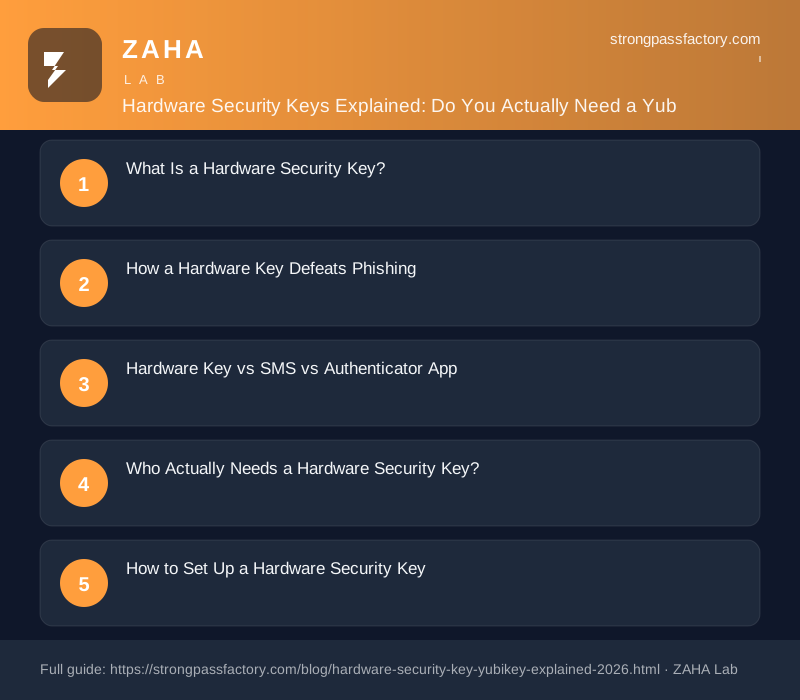
What Is a Hardware Security Key?
A hardware security key is a small physical device, typically USB-A, USB-C, or NFC-capable, that implements the FIDO2/WebAuthn open standard to authenticate you to websites and services. When you sign in, the site sends a challenge; the key signs it with a private cryptographic key stored inside tamper-resistant hardware; the site verifies the signature with the matching public key it already holds. There is no code to type, intercept, or phish.
The most widely known brand is YubiKey, made by Yubico, but alternatives exist: Google's Titan Key, Feitian devices, and others. The underlying FIDO2 standard is the same across brands, so a YubiKey works on the same sites as a Titan Key or any FIDO2-certified device. The hardware is cheap, typically $25 to $65, compared to the cost of a single account takeover.
How a Hardware Key Defeats Phishing
The protection comes from a property called origin binding. When you register a key with a website, the key creates a key pair and records the exact domain, say, google.com. When you authenticate, the challenge includes that domain, and the key signs it. A phishing site at g00gle.com sends a different domain in the challenge, one the key has never registered, so the key refuses to respond. The attacker gets nothing, even if you physically plugged the key into your laptop on the fake page.
This origin check happens inside the hardware device, not in the browser or on a server. Three authoritative bodies have weighed in on the consequence:
- The FIDO Alliance, the industry consortium behind the standard, describes FIDO2 hardware keys as the gold standard for phishing-resistant authentication, because the origin binding cannot be overridden by software on the host computer.
- NIST SP 800-63B, the US federal guideline on digital identity, classifies FIDO2 hardware authenticators at Authenticator Assurance Level 3 (AAL3), the highest tier, required for US government high-value accounts.
- Google's internal security team reported that after switching 85,000 employees to hardware keys, account takeovers dropped to effectively zero, a result that held for two years across one of the most targeted organisations on the internet.
Hardware Key vs SMS vs Authenticator App
| Method | Phishing resistant? | SIM-swap risk? | Requires carrying something? | Works offline? |
|---|---|---|---|---|
| SMS code | No | Yes | Phone | No |
| Authenticator app (TOTP) | No — code can be relayed | No | Phone | Yes |
| Hardware security key | Yes — origin-bound | No | Physical key | Yes |
| Passkey (synced) | Yes | No | Any synced device | Usually |
Passkeys and hardware keys use the same underlying FIDO2 standard, so both are phishing-resistant. The practical difference: a passkey syncs across your devices through a cloud keychain or password manager, while a hardware key stores everything locally in tamper-resistant hardware that never transmits the private key anywhere. For most people, passkeys are the easier first step; for accounts that demand the highest possible assurance, a hardware key adds a physical factor that no remote attacker can ever reach.
Who Actually Needs a Hardware Security Key?
Hardware keys are not for everyone. Here is an honest breakdown of who benefits most:
- Journalists, activists, executives, and politicians. Anyone whose accounts are likely targets for state-sponsored or well-funded attackers. Google's Advanced Protection Program, designed for high-risk users, requires hardware keys specifically because no other method holds up under determined, targeted attack.
- People with financial authority. If you can wire money, approve payroll, or access corporate banking, losing that account is catastrophic. A hardware key makes remote credential theft near-impossible.
- IT administrators and developers. Admin access, cloud infrastructure, and code-signing keys are premium targets. Many organisations now mandate hardware keys for privileged access roles.
- Privacy-conscious individuals. If you have already set up a password manager, a strong master password, and an authenticator app, a hardware key is the logical next step for email and financial accounts.
If you are an everyday user whose accounts are not specifically targeted, a good authenticator app, or better yet, passkeys, gives you most of the protection with far less friction. You do not need to carry a physical key for every account.
How to Set Up a Hardware Security Key
- Buy a certified key, and get two. A YubiKey 5C NFC (USB-C with NFC) covers modern laptops and phones. If your machine only has USB-A ports, the YubiKey 5 NFC is the equivalent. Buy two: one for daily use and a backup you keep somewhere secure. A lost key with no backup can lock you out of your own accounts.
- Register it on your most important account first. Go to the security settings of your email provider, financial institution, or password manager. Look for “Security keys” or “FIDO2 / WebAuthn” under two-factor authentication options.
- Insert or tap the key, then touch the gold sensor. The site will prompt you to tap the small disc on the key to confirm physical presence. This touch check prevents software on your computer from triggering the key silently without your knowledge.
- Register a backup key immediately. Add your second key to the same account before you rely on the first. Where a site only allows one key, generate and save backup codes in a sealed envelope stored offline at home.
- Test before you depend on it. Sign out and sign back in with the key on your main browser and on your phone. Confirm the flow works on every device you use for that account before moving on to the next one.
Hardware Keys and Your Password Manager
The most overlooked place to add a hardware key is your password manager. Your manager unlocks every other account you own, so protecting it with the strongest possible second factor is the highest-leverage security upgrade you can make.
NordPass supports hardware security keys as a second factor for vault access, alongside biometrics and an authenticator app. Combined with a strong master password, this means an attacker who somehow steals your master password still cannot access your vault without physically possessing your key, a combination that is nearly impossible to pull off remotely. NordPass uses zero-knowledge, XChaCha20 encryption, stores your passkeys and passwords in the same encrypted vault, and syncs across all your devices. Protecting the vault itself with a hardware key gives you layered security at every level, from the credentials stored inside to the vault door itself.
The Catch: Hardware Keys Require Physical Discipline
A hardware key only protects you if you have it with you. Forget it at home when you need to log in from a different location and you are back to using your backup method, likely an authenticator app, one of the methods the key was supposed to replace. Most people attach a key to their keyring or keep a USB-C key in their laptop bag so it is always present.
The second discipline requirement is the backup plan. Register a second key or save backup codes before you lock in the primary key as your only option. Hardware keys fail rarely, but they do fail, and losing account access because your only recovery path was a key that broke or was lost is a preventable disaster. Treat the backup key like a spare house key: kept safely, accessible when needed.
Affiliate disclosure: Some links in this article are affiliate links. If you sign up through them we may earn a small commission at no extra cost to you. Our password generator is free to use and we only recommend tools we would use ourselves. See our full affiliate disclosure.
FAQs
Is a hardware security key the same as a passkey?
They use the same standard (FIDO2/WebAuthn) but differ in where the private key lives. A passkey is stored in software, in your device's keychain or a password manager, and syncs across devices via the cloud. A hardware security key stores the private key in tamper-resistant hardware that never syncs anywhere, which makes it resistant to remote extraction. Think of a passkey as the convenient everyday option and a hardware key as the maximum-assurance option for your most critical accounts.
Can I use a hardware security key with my phone?
Yes. NFC-enabled keys like the YubiKey 5 NFC tap against your phone like a contactless payment card. USB-C versions connect directly to modern Android phones and recent iPhones via the Lightning or USB-C port. Check the key's product page for NFC or USB-C support before buying if you plan to authenticate on mobile, most current models support both.
What happens if I lose my hardware security key?
If you registered a backup key or saved backup codes when you set up the first one, you can access the account through those. If you did not, recovery requires going through the platform's identity verification process, which can take days and may not always work for every account type. This is why setting up a backup before you depend on the primary key is non-negotiable. Treat it with the same care as a physical house key.
Which hardware security key should I buy?
For most people, a YubiKey 5C NFC (USB-C with NFC) covers both modern laptops and phones with one device. If your machine only has USB-A ports, the YubiKey 5 NFC is the equivalent. The Google Titan Key is a strong alternative, especially within Google's ecosystem. Buy from established vendors with FIDO2 certification and avoid unbranded cheap alternatives, the security properties depend on the quality of the hardware, not just the standard name.
Do hardware keys work on all websites?
No, but support has grown significantly since 2022. All major platforms, Google, Microsoft, Apple, GitHub, Twitter/X, Dropbox, and most large financial institutions, accept FIDO2 hardware keys today. Smaller services may only offer SMS or authenticator apps. Start by adding your key to the accounts that matter most, and add others as their support improves. The FIDO Alliance keeps an updated list of compatible services at its website.