July 19, 2026 · ZA Tanoli
Google Passkeys in 2026 — Are Passwords Finally Dead?
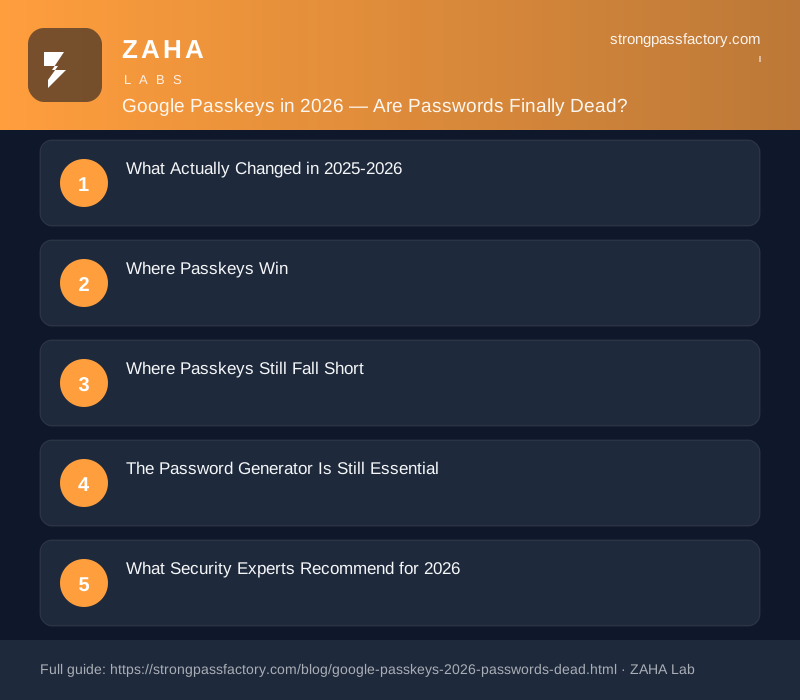
Every few years someone declares passwords dead. This time, the declaration comes with actual infrastructure backing it — Google, Apple, and Microsoft have all shipped passkey support in 2025-2026. But does that mean you can stop using your password generator? Not quite.
What Actually Changed in 2025-2026
Passkeys aren't new — the FIDO Alliance standardised them years ago, and Android and iOS have supported them since 2023. What changed is enforcement. Google's 2025 mandate for passkey-based recovery and Microsoft's deprecation of basic auth pushed passkeys from optional feature to default authentication method for hundreds of millions of accounts.
The numbers are striking:
- Over 8 billion passkeys created across Google, Apple, and Microsoft platforms by mid-2026
- Phishing success rates on passkey-protected accounts: near zero (passkeys are domain-bound and cannot be redirected)
- Password reset requests dropped 40% for Google accounts enrolled in passkeys
- Enterprise passkey adoption reached 34% of Fortune 500 companies
Where Passkeys Win
Passkeys solve problems passwords were never designed to handle:
- Phishing resistance. A passkey is cryptographically bound to the domain it was created for. Even if a user lands on a convincing login.fakegoogle.com, their passkey simply won't work. This single property eliminates the most common credential theft vector.
- No reuse. Every passkey is unique per service. There's no equivalent of "password reuse" with passkeys — each one is independently generated by the device.
- No memorisation. You don't need to remember a complex string of characters. The device handles authentication with biometric or PIN verification.
- Cross-device sync. Apple's iCloud Keychain, Google Password Manager, and Microsoft Authenticator all sync passkeys across devices using end-to-end encryption.
Where Passkeys Still Fall Short
The technology is impressive, but it's not a complete replacement — yet.
- Account recovery. Lose your device and all its synced passkeys? Recovery still falls back to... passwords. Google requires a backup password or recovery codes. Apple requires your iCloud password. Passkeys solve the daily auth problem, not the recovery problem.
- Shared accounts. Family accounts, team logins, shared streaming subscriptions — passkeys don't handle multi-user scenarios gracefully. You can't "share" a passkey the way you can a password.
- Legacy services. Millions of websites still don't support passkeys. Every browser extension, legacy SaaS tool, and niche platform still expects a username and password.
- Cross-platform friction. Android passkeys don't sync to iOS natively. If you switch ecosystems, you're starting from scratch.
The Password Generator Is Still Essential
Here's the critical point most passkey coverage misses: passkeys don't eliminate passwords — they reduce the surface area where you need them. Every service that doesn't support passkeys still requires a strong, unique password. Every account recovery flow requires a backup password. Every shared login requires one.
This is where a reliable password generator remains essential. Even in 2026, the average person manages 20-30 passwords for services that don't support passkeys. Those passwords need to be random, unique, and at least 16 characters long — exactly what a good generator produces.
The real shift isn't passwords vs passkeys. It's moving passwords from your primary auth method to your backup auth method. And your backups need to be just as strong as your primary.
What Security Experts Recommend for 2026
- Enable passkeys everywhere they're supported. Start with Google, Apple, and Microsoft accounts — the platforms that handle your recovery chain.
- Generate strong backup passwords. Every passkey-enabled service still needs a backup password or recovery code. Generate them with a random password generator and store them in a password manager.
- Keep your password manager. Services that don't support passkeys need generated passwords. Your password manager is still the central hub.
- Use a separate generator for recovery codes. Recovery codes should be generated offline with maximum entropy — not by the same system that produces your daily-use passwords.
- Review and rotate every 6 months. As more services adopt passkeys, your password profile changes. Review which accounts still need passwords and which have moved to passkeys.
The Bottom Line
Passkeys are the most significant improvement to online authentication in decades. They solve phishing, reuse, and memorisation — three of the biggest problems with passwords. But they don't eliminate the need for strong, randomly generated passwords. Not yet.
For 2026, the smart approach is both. Enable passkeys on every service that supports them. And for everything else — backups, shared accounts, legacy services — keep generating strong, unique passwords with a tool like BestPasswordGenerator. Passkeys handle the daily login. Passwords handle everything else.